
It Began Around a Campfire…
THE SIBERIAN TIGER PROJECT - BANOVICH WILDSCAPES FOUNDATION (PART 1/3)
How an unlikely conversation between Russian and American scientists became one of the world's most important long-term tiger research projects.
Some conservation stories begin with a crisis. This one began with a campfire.
It was 1989, deep in the wilderness of Idaho. A delegation of Soviet scientists was visiting the United States, where American researchers were conducting long-term studies of mountain lions using what was then cutting-edge radio-telemetry technology.
Around the fire one evening, the conversation turned to another great cat.
The Amur tiger.
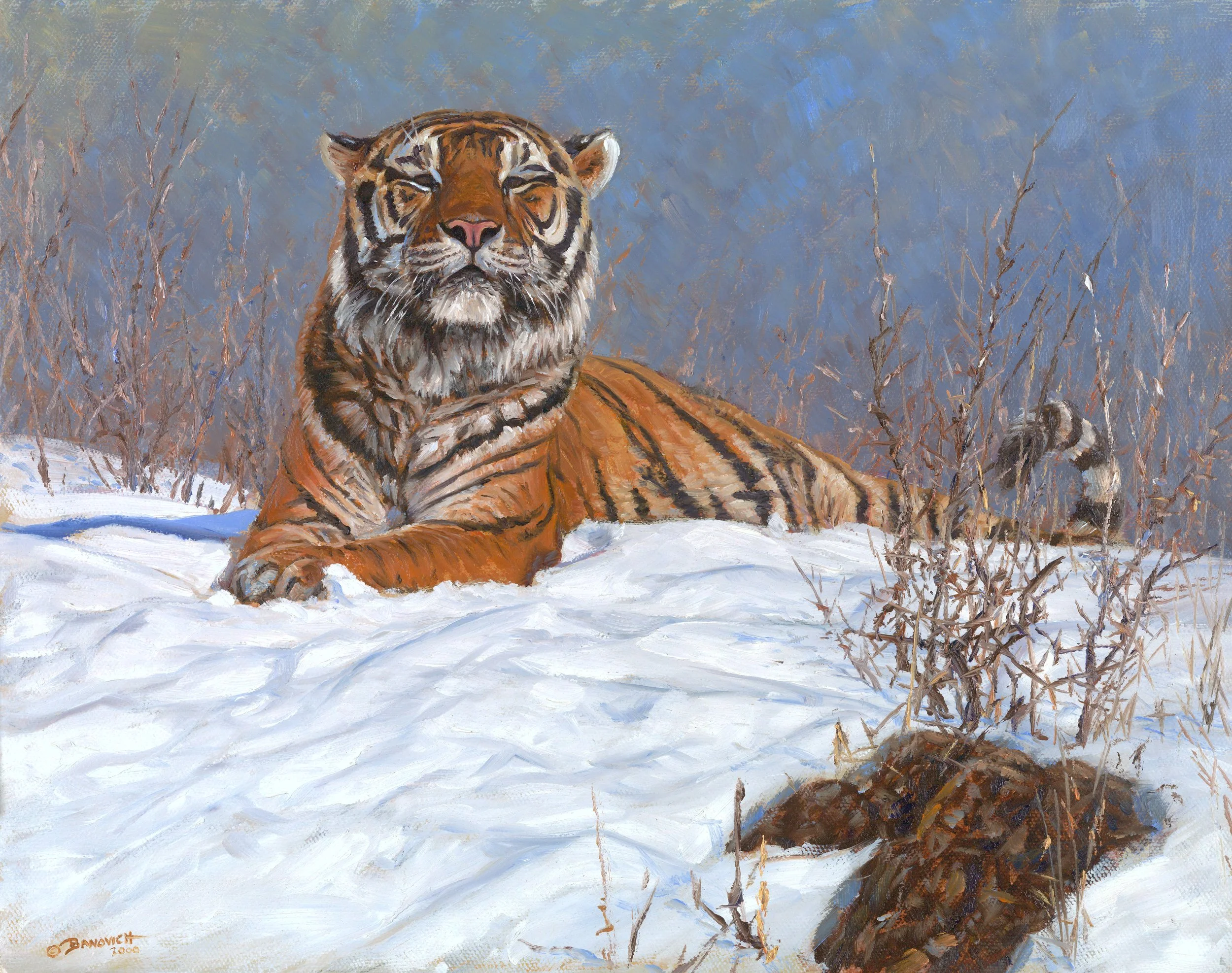
John Banovich, Siberian Tiger, Limited Edition Giclée Canvas, Gallery Edition- 11" x 14"
Half a world away, in the forests of Russia's Far East, Russian biologists possessed an extraordinary kind of knowledge. For years, they had followed tigers through winter snow, reading tracks and signs across an immense frozen landscape.
These were field scientists who knew how to read a tiger's world… A footprint could reveal direction, a trail could reveal movement, the remains of prey could reveal hunting behaviour, and a succession of tracks through the snow could gradually reveal the life of an animal that was almost never actually seen.
But there was a problem.
When winter ended and the snow disappeared, much of that window into the tiger's life disappeared with it.
The Americans had technology. The Russians had extraordinary field knowledge.
Around that campfire, someone asked a remarkably simple question:
What would happen if we put the two together?
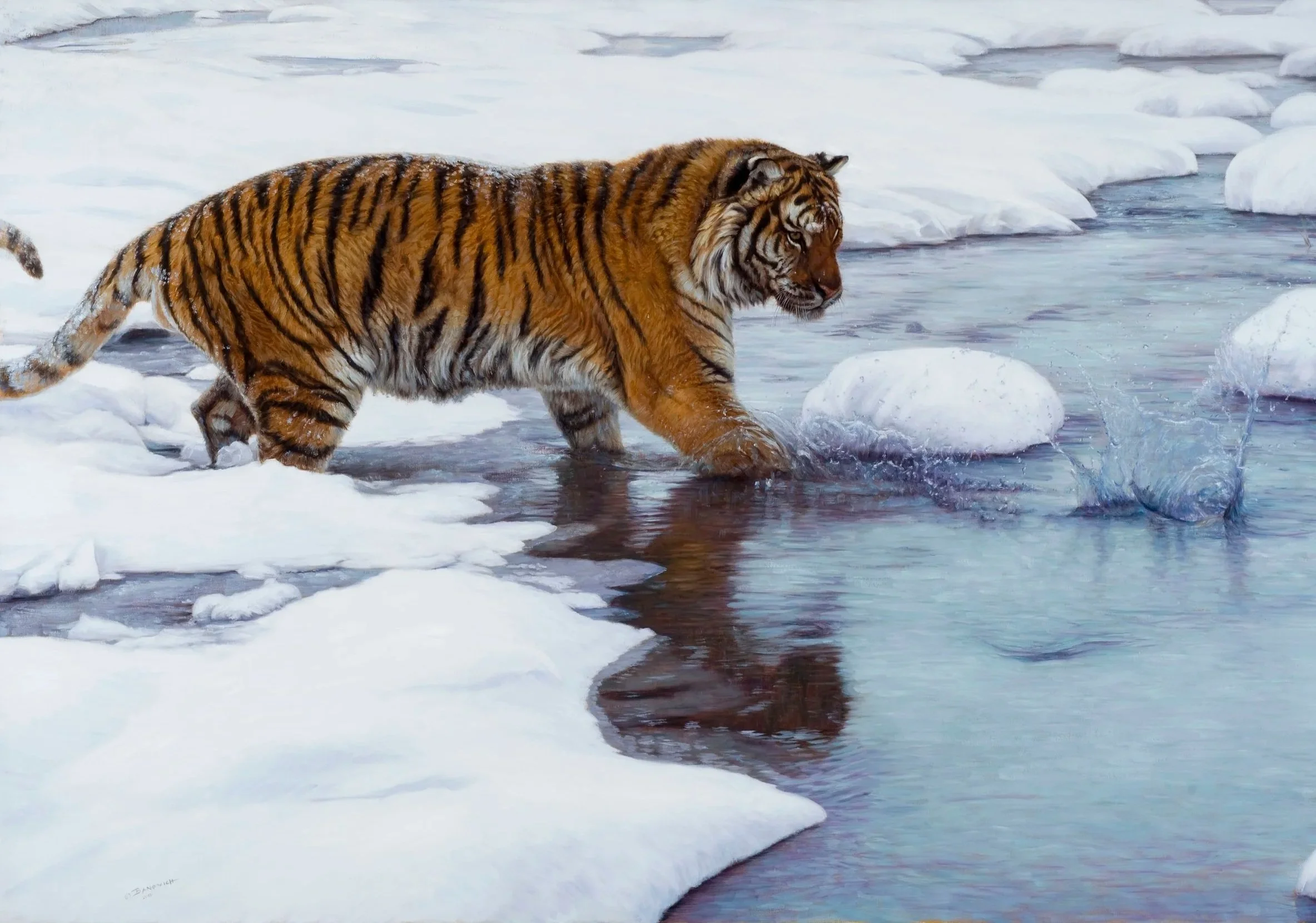
John Banovich, Siberian Tiger in Water (SOLD)
From Idaho to the Russian Far East
It was an ambitious idea. Perhaps an improbable one.
The Cold War was only just ending. Political uncertainty was enormous. Funding was difficult to find. Some specialists doubted that a radio-telemetry study of wild Amur tigers could work at all.
The animals were too elusive. The landscape was too vast. Capturing enough tigers to generate meaningful scientific information seemed almost impossible. And yet, on January 7, 1992, four American scientists arrived in Khabarovsk carrying equipment, expertise and an idea that had survived all the reasons it might never happen. From there they travelled into the Sikhote-Alin Mountains and eventually to the remote coastal village of Terney.
It was winter. The forests seemed endless. There were language barriers, cultural differences and plenty of uncertainty on both sides. But there was also something considerably more important - A shared fascination with tigers.
The basic plan appeared straightforward: combine American telemetry and wildlife-handling techniques with generations of Russian knowledge of the taiga and its tigers.
In practice, almost nothing about it was straightforward. Finding the animals was difficult. Capturing them was harder. Weeks could pass with little more than tracks in snow and failed attempts. The future of the fledgling project depended on proving that what had been imagined around that Idaho campfire was actually possible.
Then, on February 11, 1992, everything changed.
The First Tiger
Researchers approaching a capture site that morning were met by the unmistakable roar of a tiger. There, in the winter landscape, was a young female. The team worked quickly, collecting measurements and biological samples before fitting the animal with a radio collar that would allow researchers to begin following her movements through the forest.
She became the first Amur tiger radio-collared by the project. And she was given a name. Olga.
No one standing in that frozen forest could have known just how important she would become… Researchers would follow Olga for the next 13 years.
Through her movements they began learning how a female tiger establishes a territory. They observed her transition from young tiger to independent adult. They followed her through motherhood. They learned about reproduction, prey, survival, territorial behaviour and the enormous landscapes these animals require. Gradually, one tiger became a window into the lives of many. And one experimental collaboration became the Siberian Tiger Project.
Knowledge Earned One Footprint at a Time
The story that followed was never simply about technology. Technology made certain questions possible to answer, but the work still depended on people.
People walking through deep snow.
People checking signals in brutal winter temperatures.
People following tracks for days.
People learning to trust colleagues with whom they sometimes barely shared a language.
Russian and American scientists brought different approaches to the forest. Over time, those differences became one of the project's strengths.
Science became common ground. The tiger became common purpose. Terney, once a remote village on the edge of the Sea of Japan, became an important centre of knowledge about one of the world's most elusive predators.
What began as an experiment developed into decades of scientific research and conservation experience. And that distinction matters. Because before we can protect an animal, we have to understand what it needs to survive.
Where does it go?
How much space does it require?
How much prey does it need?
How long do cubs remain with their mothers?
Why do some animals survive while others don't?
What happens when roads enter tiger habitat?
What happens when prey disappears?
What happens when human pressure increases?
Those questions cannot be answered by a photograph, a single expedition or even a single year of research. They require time. Sometimes decades.
A Legacy Worth Protecting
Today, as the Banovich Wildscapes Foundation becomes part of the next chapter of the Siberian Tiger Project, it is important that we begin by understanding where this remarkable story came from.
Because we are not starting something new. We are helping carry something forward. A legacy built by scientists, field biologists, conservationists and communities who spent decades piecing together the secret life of the Amur tiger. The knowledge they created cannot simply be recreated if it disappears.
There is another reason this story matters deeply to us...
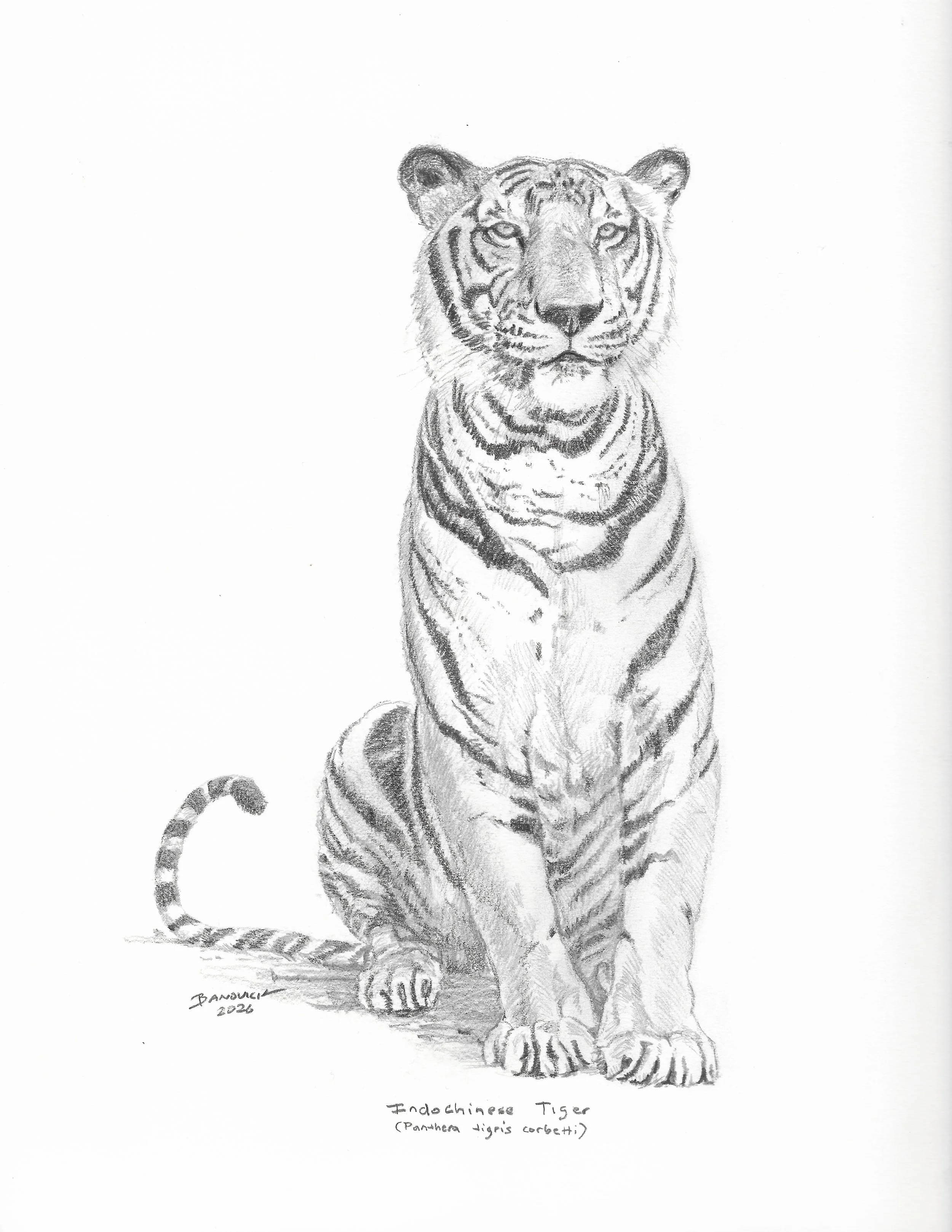
John Banovich, Indochinese Tiger Sketch, Pencil, 12h x 9w in | 30.48h x 22.86w cm
For John Banovich, conservation has always begun in exactly the same place: understanding.
Before an animal becomes a painting, there is observation. Time in the field, behaviour studied, landscapes understood, conversations with the people whose lives are devoted to protecting wild places.
Art can make us feel something for wildlife. Science helps us understand what wildlife needs. Conservation turns that understanding into action. The Siberian Tiger Project brings those worlds together in an extraordinary way.
Over the coming months, we are going to share its stories - the scientists, the landscapes, the discoveries, and, most importantly, the tigers themselves.
Beginning with the young female who changed everything. Her name was Olga.
