
THE SIBERIAN TIGER PROJECT - BANOVICH WILDSCAPES FOUNDATION
She was the first tiger of the Siberian Tiger Project. For 13 years, her life helped scientists understand how to protect an entire species.
The first thing Dale Miquelle heard was the roar. It was February 11, 1992, in the frozen Russian Far East. Somewhere less than 40 metres away was a wild tiger. For the scientists attempting something that had never before been achieved by their new Russian-American research team, this was the moment everything had been building towards.
The tiger was a young female, little more than a year old. She was safely immobilised, measured and fitted with a radio collar. Then the researchers moved away and watched from a distance as she recovered and disappeared back into the forest.
They named her Olga.
She became the first tiger radio-collared by the Siberian Tiger Project. But Olga would become far more than its first research animal. For the next 13 years, she would become one of its greatest teachers.
How Do You Know a Tiger You Hardly Ever See?
That is perhaps the most extraordinary part of Olga's story.
The researchers didn't spend their years sitting beside her watching her life unfold - quite the opposite. During 13 years of following Olga, sightings were extraordinarily rare. Instead, scientists learned to know her through fragments… A radio signal, tracks pressed into snow, the remains of a deer, a change in movement, the place she chose to rest, the territory she travelled, and evidence that cubs were nearby.
One observation on its own might reveal very little. But collect those observations over months, years and eventually more than a decade, and something extraordinary happens. A life begins to emerge, and with it comes knowledge that can help protect other tigers.
From Daughter to Independent Tigress
When researchers first met Olga, she was still travelling with her mother. By following her movements, they were able to watch the gradual transition towards independence and learn something important about how female Amur tigers establish their own lives. Olga eventually remained close to the area in which she had been raised.
Researchers began seeing evidence of a pattern they would later observe in other tigresses: mothers could effectively make space for their daughters within or alongside familiar territory. For a young tiger, that familiarity matters. She already knows the landscape, including where prey may be found, where she can rest, and where danger may lie.
Olga was showing researchers something they had not previously been able to document in this way, and she was only getting started.
Then Olga Became a Mother
In 1994, researchers noticed that Olga's movements had changed. For weeks she remained unusually close to one location. There was a strong possibility that she had cubs.
A National Geographic film crew joined researchers as they waited nearby, hoping for an opportunity to investigate without disturbing her. They waited for six days. Finally Olga moved away to hunt. Researchers entered the area and discovered a tiny cub hidden beneath the roots of a fallen tree. They named her Dasha.
Over Olga's lifetime, researchers documented six litters and at least 13 cubs. They knew that at least six survived long enough to become independent. Suddenly, the project wasn't merely following a tiger, it was following generations. And this is where the value of long-term wildlife research becomes so clear. A study lasting two or three years may tell us where an animal goes. A study lasting more than a decade can begin to tell us how a life unfolds.
How often does a female reproduce?
How many cubs might she raise?
How long can she hold a territory?
How does she hunt while supporting growing offspring?
What happens as she ages?
And ultimately, what threatens her survival?
Olga helped answer questions that simply cannot be answered quickly.
A Tiger Becomes a Neighbour
Something else happened as the years passed. The people of Terney began asking about Olga. She was no longer simply an anonymous tiger somewhere beyond the village. She had a name. People knew researchers were following her life. They heard stories of where she had travelled and whether she had cubs. She became a familiar presence without being a familiar sight, and something subtle began to change.
A tiger could be feared as an unseen predator, but Olga was becoming an individual - a neighbour of sorts, an animal whose life people were curious about, and an animal people wanted to know was still out there.
That transformation, from a tiger to Olga, may be one of the most important lessons in conservation storytelling. We protect populations with science, but often, we first learn to care through individuals.
Thirteen Years
As Olga grew older, researchers continued replacing her radio collar so that they could keep learning from her. By then she had become an icon for the project. With each passing year her story became more scientifically valuable because long-term information of this kind is extraordinarily difficult to obtain from wild animals. She had survived bitter winters, raised cubs, defended a territory, hunted through deep snow, avoided countless dangers, and allowed researchers to understand the world of an Amur tiger in a way that had previously been impossible.
Then, in January 2005, Olga was killed by a poacher.
For the researchers who had followed her life for 13 years, it was more than the loss of a study animal. They had spent more than a decade trying to understand what would allow tigers like Olga to survive. Her death demonstrated just how vulnerable even a well-established adult tiger remained to human pressure.
But Olga's story did not end there.
She Became Knowledge
Olga's movements became data. Her motherhood became knowledge about reproduction. Her territory contributed to understanding how female tigers use landscapes. Her relationship with her offspring helped reveal how generations establish themselves. Her survival, and ultimately her loss, helped scientists better understand the threats facing wild tigers.
That knowledge travelled far beyond one animal. It informed conservation and it became part of a body of research that would continue growing for decades. There is something deeply important in that.
Olga was never just a data point. She was a wild tiger living the only life she knew. The scientists studying her understood that. They rooted for her, they watched for her radio signal, they wondered where she was, hey celebrated her cubs, and through knowing one animal extraordinarily well, they learned things that could help many others.
Today, as we help carry the legacy of the Siberian Tiger Project forward, these are the stories we want to preserve alongside the science - because behind every spreadsheet, tracking record and research paper is something real.
A footprint. A forest. A researcher standing in the snow. A tiger somewhere beyond sight. A life. And sometimes, that life has a name…
Olga.
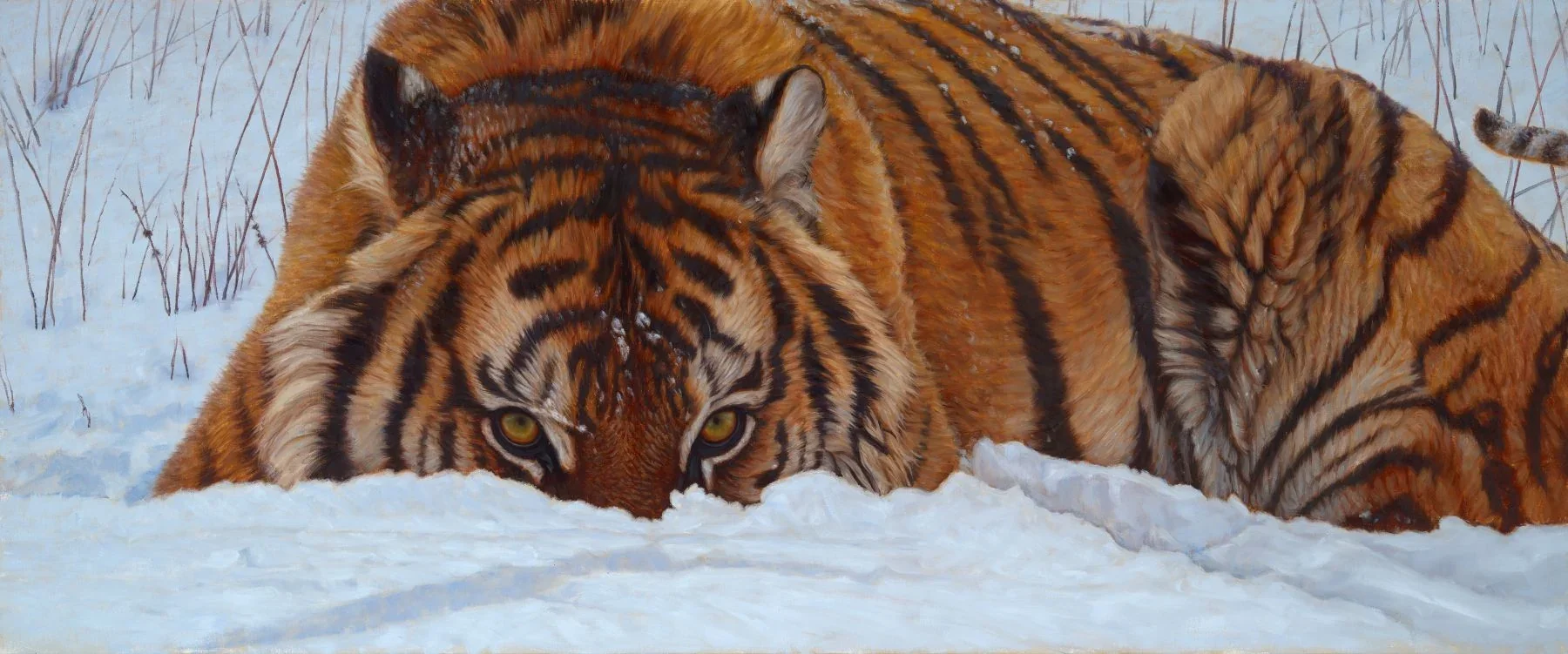
John Banovich, The Ambush, Limited Edition Giclée Canvas, Gallery Edition - 17" x 40" | Studio Edition: 28" x 66"
A PORTION OF THE PROCEEDS OF THIS EDITION DIRECTLY SUPPORTS THIS PROJECT.
